

Resources > Short-handed marketer

How a short-handed marketer can make a real impact next quarter

Short-handed marketers don't lose because their team is small.  They get lost when they walk into the quarter with no prep and try to do everything at once in isolation.  Win your quarter in the 30 days before it starts: pick your one metric, your say-no rule, your lead channel, your rhythm, your plan. Focus beats headcount.

Introduction

Every good restaurant’s kitchen knows a secret that most marketing teams don't: the dinner rush is won before a single guest sits down.

By the time the orders come in, it is too late to think. The line cooks are not deciding what to make or how to make it; they are executing the plan and prep they did hours earlier, calmly, because the mise en place is done. Everything is in its place. The chaos of service is survivable only because the plan and the prep happened before the doors opened.

Now picture another kitchen. No prep, no plan, two cooks trying to chop, sear, plate, and expedite all at once as the orders stack up. They are moving constantly. They are also drowning. Nothing that leaves the pass is their best work, and at the end of the night they could not tell you what went wrong, only that they never stopped.

That second kitchen is most short-handed marketing teams, and not because they are lazy or unskilled. It is because the quarter started and they were still reacting, taking the newest order from sales, the founder, or product, instead of running prep they had decided on before it began. You are busy from the first email to the last. You close forty tabs a day (and open twice as many). And ninety days later you cannot point to the one dish that actually sold.

Here is the good news: a team of one or two can absolutely run a great service. But you win it in the prep, in the roughly thirty days before the quarter starts. This is the mise en place for your quarter. And the very first thing on the prep list is a number almost no marketer has ever actually worked out.

Lead cost vs. lead value

Try this. Put fifty marketers in a room and ask who knows their cost per lead. Nearly every hand goes up. It is the number the ad platform reports, the number finance asks about, the number you defend in every budget meeting. The average B2B lead, across industries, runs about $198 to acquire, and most of us can quote our own version without looking.

Now ask the same room a different question: who knows what a lead is worth? What one lead, on the way in, is actually worth to the business . . . in dollars?

The hands go down. Almost every one.

That is the strangest gap in marketing. It is like a kitchen that knows exactly what its ingredients cost but has never once worked out what a finished plate earns. You cannot run a menu that way, and you cannot run marketing that way, because without the second number, the first one is meaningless. Is a $200 lead expensive? You have no idea. You literally cannot know whether you are paying more or less than a lead is worth until you know what it's worth. Most teams are flying blind on the single most important trade in their business.

So let's work it out. It's simpler than it sounds, and you can do it on the back of a napkin with me right now.
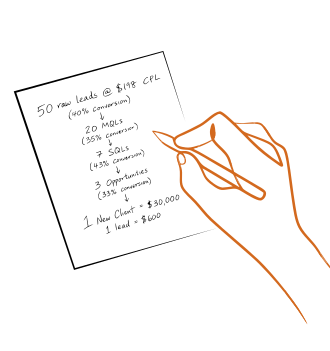

Napkin math: 50 raw leads at $198 CPL converting down to 1 new client worth $30,000 — 1 lead is worth $600.Napkin math: 50 raw leads at $198 CPL converting down to 1 new client worth $30,000 — 1 lead is worth $600.

Start with a closed client and walk backward through your funnel to one lead. Say a new client is worth $30,000 in their first year. On typical B2B benchmarks, a lead becomes a customer only about 2 to 4% of the time end to end (fewer than 4 in 100 leads typically become customers). Call it one client for every forty to fifty leads.

So one lead is worth about $600. That's $30,000 divided by fifty. If you know your own conversion numbers, use those to calculate your own lead value.

Sit with that for a second, because it changes everything downstream. If a lead is worth about $600 and you are buying leads for about $200, you are not overspending; you are getting a steal.

Or, look at it this way: if a lead is worth $600 and you let 5 a week (1 per workday) go cold because you are too slammed to follow up, you are pouring roughly $3,000 a week down the drain and calling it "being busy."
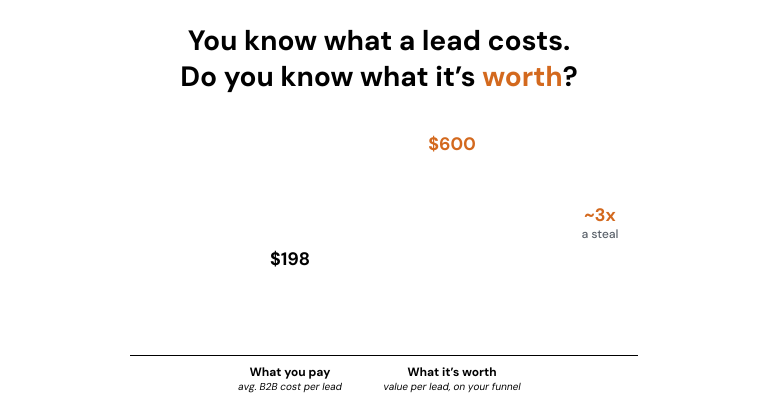
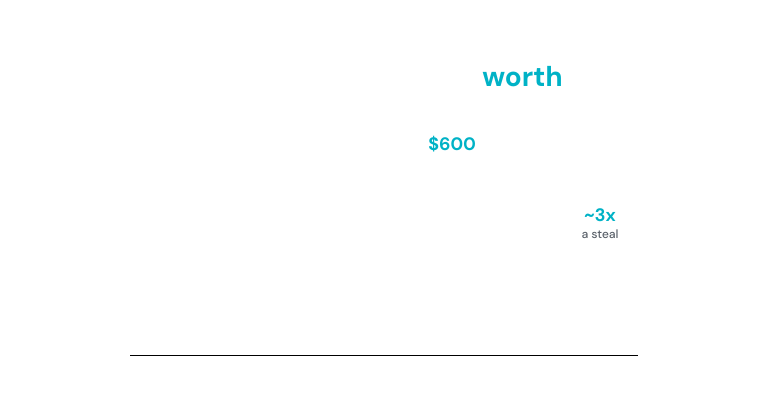
Funnel breakdown: 50 raw leads at $198 CPL, 40% conversion to 20 MQLs, 35% conversion to 7 SQLs, 43% conversion to 3 opportunities, 33% conversion to 1 new client worth $30,000 — 1 lead is worth $600.Funnel breakdown: 50 raw leads at $198 CPL, 40% conversion to 20 MQLs, 35% conversion to 7 SQLs, 43% conversion to 3 opportunities, 33% conversion to 1 new client worth $30,000 — 1 lead is worth $600.

That number reframes every decision you are about to make about your quarter.

One decision to make before you trust the lead value the number: are you counting the first year, or the whole relationship? A client worth $30,000 in year one might be worth $90,000 over three years before they churn. Value a lead on first-year revenue, and you get a conservative, defensible number for budgeting this quarter. Value it on its lifetime value, and you can justify spending more to land each one, because you know what it pays back over time. Neither is wrong. Just be honest about which you are using, and use the conservative one when the decision involves real spend.

And yes, your number will be different from mine, probably by a lot. It moves mostly with your own conversion rates, which almost certainly aren't the same as the benchmark we used here. Every stage where you beat the average makes each lead worth more; every stage where you lag makes it worth less. Benchmarks are a placeholder for a number you should eventually own.

That's the whole method. Find your client value, decide first-year or lifetime, divide by the leads it takes to land one, and you have a lead value you can actually plan around. You do not need anything but your own numbers and a minute.

Being short-handed is not a bad omen.

Before we start prepping, let me kill the guilt, because most short-handed marketers quietly believe the real problem is simply that there aren't enough of them. The data says otherwise.


Team-size benchmarks: companies in the $1 to 10 million revenue band run a median of three marketers; SaaS teams run two to four marketers at Series A and twelve to twenty-five by Series C.Team-size benchmarks: companies in the $1 to 10 million revenue band run a median of three marketers; SaaS teams run two to four marketers at Series A and twelve to twenty-five by Series C.

Companies in the $1 to 10 million revenue band run a median of three marketers (DigitalApplied, 2026). SaaS teams usually run two to four marketers at Series A and only twelve to twenty-five by Series C (MarketerHire, 2026).

As is often the case, the magic is in the outliers. One of our clients is a thriving $500 million-plus company with a marketing team of exactly one. We have worked with a Series D company running on two. Small is not a phase you are stuck in until you become real. For many very real, very successful companies, small is the design.

The marketing team of one has been called the hardest job in marketing because you do it all alone. But hard and hopeless are different things. The best small kitchens in the world are not the ones with the most cooks. They are the ones with the tightest prep and the shortest menu.

And the numbers back that up: among the 61% of B2B marketers whose results improved last year, 74% credited a sharper strategy, and only 16% credited a bigger budget (Content Marketing Institute, 2026).
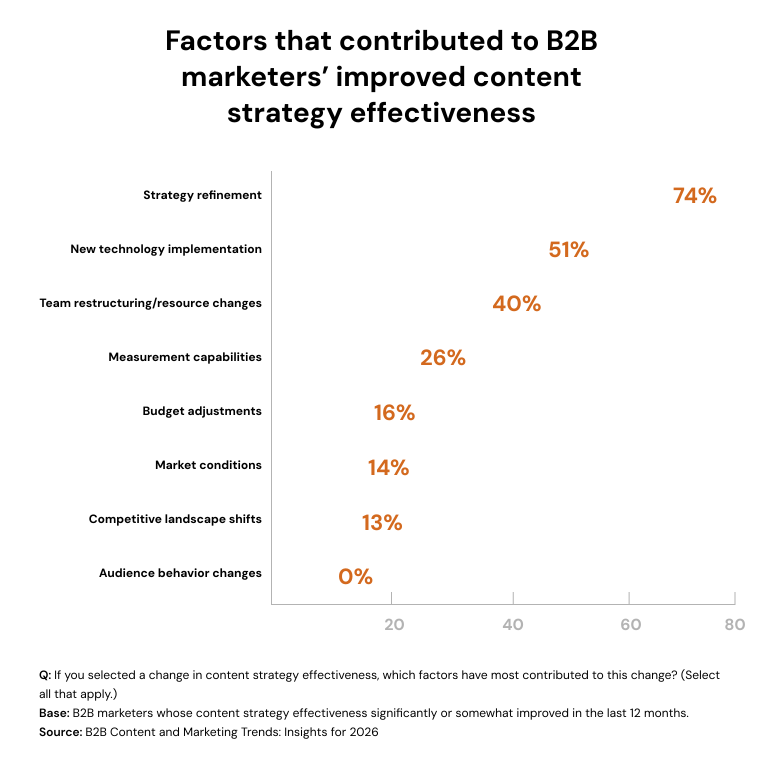
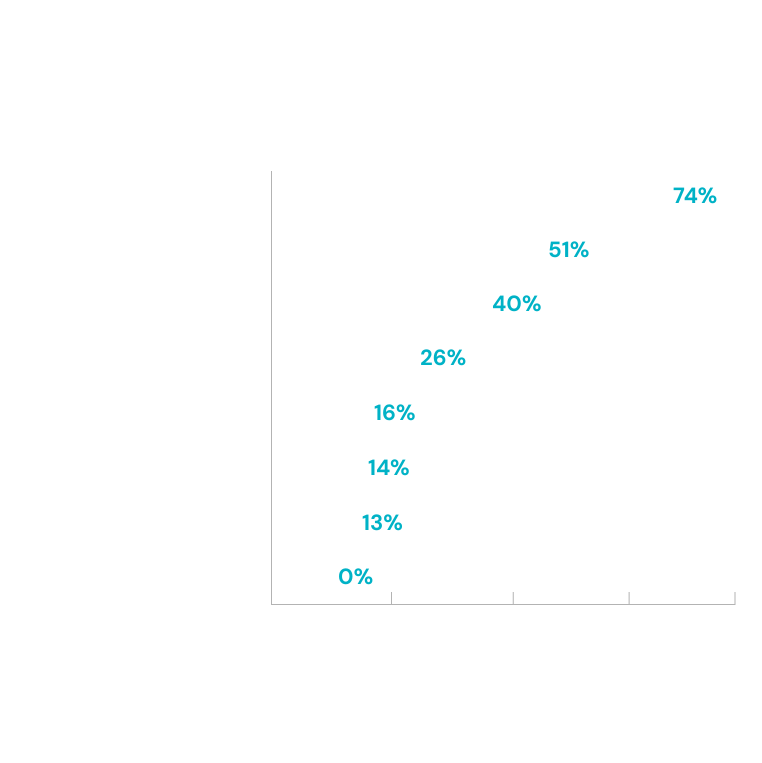
Illustration supporting the point that a focused team of one outproduces a scattered team of five.Illustration supporting the point that a focused team of one outproduces a scattered team of five.

As a short-handed marketing team, your effectiveness is not about doing more.

Your effectiveness is about doing less, on purpose, and doing your prep before the rush. Here is the prep list.

Win the quarter in the thirty days before it starts

This is your formula: Five things get decided before the doors open. Then two habits carry you through service. That is the whole quarter.

The five prep steps are not glamorous, which is exactly why reactive teams skip them and then wonder why the night falls apart. Do them in order. Each one makes the next easier, the way stock has to be made before the sauce.

Step 1. Pick the one metric that matters

Before anything else, choose the single number this quarter is judged on, and get your leadership to agree to it. We borrow the phrase from Lean Analytics: the One Metric That Matters. Not five goals. One. This is your special, the dish the whole night is built around. Everything else on the menu supports it.

How do you pick it? Start from the business, not from marketing. Ask what the company most needs in the next ninety days: pipeline for a specific product, renewals in a specific segment, qualified demos from a specific vertical. Then choose the marketing number closest to that need that you can actually influence. Say your company needs pipeline for its Green product; your metric is qualified opportunities for that product. Not traffic. Not impressions. Not all three at once.

Getting sign-off is half the play, and it is the half small teams skip. Take your one number to your founder before the quarter starts, in a single sentence: "This quarter, marketing is judged on [Green Opportunities], because [Green pipeline] is what moves the business."

When leadership agrees up front, you get two things:

  1. Cover to say no later (without having to say no)
  2. Freedom from being graded on a target that moves every week

A metric nobody agreed to is just a number you will be blamed for missing.

For example, a two-person SaaS team whose company needs pipeline for one product sets its quarterly metric as qualified opportunities for that product, gets the CEO to agree in writing, and lets that one number settle every "should we also do X" argument for ninety days.

Step 2. Set your say-no rule

A short menu signals quality, not limitation. Remember the math: if a lead is worth $600, the hours you lose to off-menu work are not free; they are pipeline you chose not to cook. So decide, before the quarter, how you will say no without becoming the person who always says no.

The rule is one question, asked out loud for every incoming request: does this move the metric we agreed on? Then, add it to a list, sorted into now, next, or not this quarter. You are rarely refusing. You are sequencing, and a schedule is far easier to agree to than a flat no.

One of our clients printed it out and hung it on his office door; another posted it as her Slack status. Do what it takes to get your company to understand that this will be your answer to (pretty much) every request. So when Sam from Sales wants you to get more leads for his Orange pipeline, or when Pete from Product wants you to survey users of the Purple product beta, your answer is (almost) always “will that move Green opportunities?”

The caveat is that you may also handle the repeat orders. A few requests come back every month: the same status update, the same "can you explain our positioning again," the same quick favor. Each one is a sign that people need something they can only get through you, so unblock them without blocking yourself. Turn the rebuilt report into a template they fill in themselves. Turn the repeated question into a doc anyone can find and forward. Turn the trickle of favors into one weekly office-hours slot. You are not blocking the request; you are taking yourself off the critical path, which is better for them and for your Green opportunities.

For example, an EdTech marketer pins one line where requests land: "If it does not move qualified demos this quarter, it goes on the next list." When the founder asks for a mid-quarter rebrand, the answer is not no. It is "great, that is a Q3 project," and everyone can see why.

Step 3. Choose your one lead channel

A chef learned a hundred techniques in culinary school. A good line cook does not use all of them every night. Pick the one channel where your buyers already pay attention and make it your lead. Lead doesn't mean only; it means the channel that gets your best thinking and most consistent effort, while everything else stays light.

Do not start with the channel you like or the one that is trending. Start with your buyer and ask three questions:

  1. Where do they already go to learn about problems like the one you solve?
  2. Where do the people they trust hang out and talk shop?
  3. Which of those places can you realistically show up in, well, every single week with the team you have?

The channel that scores highest on all three is your lead.

For example, a lean consulting firm's buyers are operations leaders who live on LinkedIn and forward posts to each other. LinkedIn becomes the lead channel; the blog and newsletter exist to replate what already worked there, not to pull the kitchen in three directions.

Step 4. Set a rhythm you can hold

Pick a pace you can hold on your worst week, then hold it. Consistency is what turns effort into effect, instead of a pile of one-off pushes.

The trick is to set the rhythm at your floor, not your ceiling. Do not plan for the quiet week with nothing else on. Plan for the week when three things are on fire, because that is most weeks for short-handed marketing teams. If all you can truly protect is one strong piece a week and one deeper piece a month, that is your rhythm. Reliability compounds. Heroics do not.

For example, a solo comms marketer commits to one point-of-view post a week and one deeper piece a month, then breaks each deeper piece down into the next month's posts. It is a pace one person can actually keep through a loud quarter.

Step 5. Write the quarter's prep list

Now turn the first four decisions into one written plan, because a plan you keep in your head is not mise en place; it is a wish. You have your metric, your channel, and your rhythm. This step is where you decide, in advance, what you will actually make over the next ninety days, and when.

Keep it simple. Pick one theme for the quarter that resonates with your audience and ladders up to your metric. Map three anchor pieces to the three months, something with weight like a teardown, a piece of original data, or a customer story. Let your rhythm fill the space between them with smaller pieces pulled from each anchor. Then leave one slot a month deliberately empty, because something always comes up, and a prep list with no slack is one you abandon by week three.

A written plan does three things a mental list cannot:

  1. It makes your “no” easier, because the calendar is visibly full of work that serves the metric.
  2. It lets you batch, so you don't start cold every week.
  3. It turns your rhythm from a wish into a schedule.

This is the moment the prep is done and the night becomes survivable.

For example, a solo SaaS marketer whose metric is qualified demos picks one quarterly theme, maps three anchor pieces to the three months, and schedules the weekly posts that break each anchor into smaller angles. The quarter is booked before it starts, and every slot points at demos.

Then two habits carry you through service

The prep is done. The doors are open. Through the whole quarter, only two things need to stay live: one you check constantly, and one you decide as the night demands it.

Good chefs don’t send out a new dish without tasting it, and no good short-handed marketer should run a quarter without one honest read on whether it's working. But you do not need forty metrics. You need one number that moves early, like inbound conversations or engaged reach, checked every week without fail, plus one honest source of truth about where good leads actually come from.

That source is not your dashboard. Your analytics can tell you where someone clicked or converted, but a lot of B2B buying happens well before that click, in DMs, peer chats, communities, Slack groups, and forwarded posts. None of it shows up in last-click attribution, which means the channel doing the most work to warm a buyer is often the one your dashboard credits the least. That's our read from years of watching where our clients' best leads come from, and it is why the most reliable instrument in the kitchen is the oldest one: ask the guest how they found you.

Add a required "how did you hear about us" question to your contact form and every discovery call, and write down the answers. Then actually read them monthly, looking for the channel or the piece that keeps showing up right before a good conversation. Remember what each of those is worth. If a lead is worth $600 and your dashboard keeps crediting "Google" while the real spark was a LinkedIn post someone forwarded, you are underfeeding your best channel and starving the pipeline you already earned. The answer to "what is actually working" is usually sitting in that one field, not in your analytics.

For example, a small team checks engaged reach every Monday as its early signal, and reads the "how did you hear about us" answers once a month. Three quarters in, the pattern is obvious, and the quarterly plan bends toward the channel that keeps showing up.

The head chef does not run every station. The last habit is the one that decides whether the first six are survivable: for every job on your plate, you have three honest options, and only three. Keep it, systemize it, or collaborate on it. Sort every gap into one of those, on purpose, before the work sorts itself onto your station by default.

Keep the work that is core to your metric and that only you do well. This is the dish you plate yourself, the reason the kitchen has your name on it. Protect it, and do not let the other two buckets crowd it out.
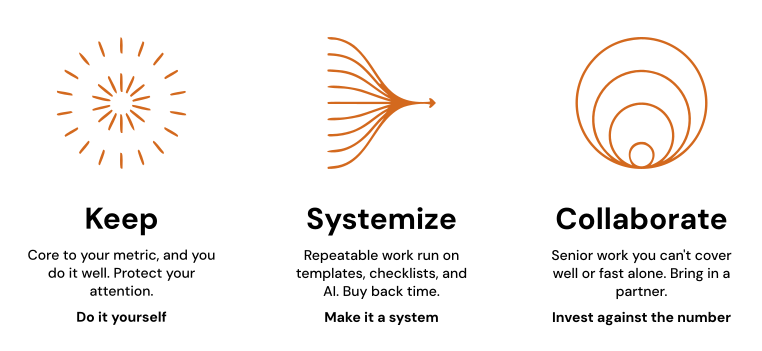

For every gap, three honest options: Keep — core to your metric, do it yourself. Systemize — repeatable work run on templates, checklists, and AI, make it a system. Collaborate — senior work you can't cover well or fast alone, invest against the number.For every gap, three honest options: Keep — core to your metric, do it yourself. Systemize — repeatable work run on templates, checklists, and AI, make it a system. Collaborate — senior work you can't cover well or fast alone, invest against the number.

Systemize the repeatable work so it runs without eating your best hours. Templates, checklists, and AI are your prep station and your immersion blender: they turn a job you redo every week into a system you maintain. This is where AI earns its place. Hand it the rote, low-judgment work, first drafts, turning one asset into five formats, synthesizing research, scheduling, so your judgment goes to the decisions that actually need a human: the angle, the argument, the offer, the read on a specific buyer. Used well, AI lets a small team produce more without giving up the judgment that makes the work high quality.

Collaborate on the senior work you cannot cover well or fast enough alone. This is the station you bring in a specialist for, and it is worth doing with intention:

  • Price it against the outcome, not the hour.
    A senior partner who gets it right the first time is cheaper than a bargain freelancer whose work you have to review, fix, and redo. Buy the result, not the rate.
  • Bring people in for a relationship, not a single plate.
    Anyone you work with has to learn your product, your offer, and your voice, and that ramp is an investment. Spend it where it pays back across many deliverables.
  • Keep the thinking and the doing together.
    Work goes to die in the handoff between the strategist who plans it and the person who executes it, and on a small team that handoff lands on you. Find one partner who owns both.
  • Pick the dish first, then staff it.
    Decide what actually moves your metric before you bring anyone in. You cannot hire your way to focus.
  • Buy a plan, not just a platform.
    A configured tool is not a strategy. Make sure you are getting judgment on what to do, not just the hands to set it up.

Here is where that lead-value number finally pays off. Once you know what a client is worth, "should I get help" stops being a feeling and becomes math. Bringing in senior help is not a cost to shave down; it is an investment against your metric. If closing a capability gap could reasonably add $300,000 in qualified pipeline, you weigh the spend against that, not against a freelancer's hourly rate. A common, conservative rule: a gap that materially lifts your metric is worth spending up to a quarter of the lift's value to close. Start conservatively with a quarter of the value of one client.

Do that math on your own numbers, and the decision to bring in a specialist, or not, gets a lot less emotional.

Collaboration is a need, not an afterthought. In fact, having been short-handed marketers ourselves many times, it is the premise of what we built our team to serve. When we take on a short-handed team's work, we lead with H.E.A.R.T: human experience, execution, AI for efficiency, results, and team. The same senior people own both the strategy and the doing, so nothing falls in the handoff.

Heart icon, for the HEART framework: human experience, execution, AI for efficiency, results, and team.

HEART is how we help a small team ship work that looks and performs like a big one.

  • Human experience of senior experts
  • Execution by detail-oriented practitioners
  • AI for efficiency in rote tasks
  • Results always at the core
  • Team that works as an extension of yours

The whole quarter, on one page

Here's the entire thing, start to finish.

Before the doors open, do your prep. Work out what a lead is actually worth, so every decision after it is grounded in a real number, not a feeling. Then make your five decisions: pick the one metric that matters, set your say-no rule, choose your one lead channel, set a rhythm you can hold, and write the quarter's plan. Walk into the quarter with the mise en place done.

Through your quarter, keep two habits: one honest measurement, and decide, gap by gap, what to keep, systemize, or collaborate on, with a real budget behind the call.

That is it. Not more hours. Not more headcount. A short-handed team does not lose because it is small. It loses because it walks into the rush with no prep and tries to cook everything at once. Do the prep, run a short menu well, and a team of one or two can deliver a quarter the whole company remembers.

The best small kitchens were never the ones with the most cooks. They were the ones that knew exactly what they were making before the first guest sat down.

Get your quarter's prep list

Everything above works on a napkin. The free quarterly planner just does it faster, on your real numbers.

It works out your value per lead and per client, shows you what reactive work is quietly costing you in pipeline, helps you pick your metric, channel, and rhythm, and tells you, gap by gap, whether to keep, systemize, or collaborate, along with the exact budget your lead value frees up to get help. Where you don't have a number yet, it fills in a cited benchmark and shows you how much of the answer is yours versus ours.

Download the quarterly planner

Prefer to talk it through with a senior team that owns both the strategy and the execution?
Book a strategic marketing consultation or Contact Our Team.

Frequently asked questions

Yes, if the focus is narrow and the prep is done. One person cannot cover every channel and every request, but one who commits to a single metric, one lead channel, and a rhythm they can actually hold will produce results that compound. The teams that struggle are not the smallest; they are the least focused.

Work backward from a closed client through your funnel. Take the value of a client, decide whether you're counting first-year or lifetime revenue, and divide by the number of leads it takes to land one. If a client is worth $30,000 and it takes fifty leads to close one, each lead is worth about $600. Use your own conversion rates rather than benchmarks wherever you have them, because your real number is what makes every budget decision defensible.

When a gap is core to your metric, sits in your lead channel, and you can't do it well or fast enough alone. Put a number on it: if closing the gap moves real pipeline, weigh the investment against that pipeline, not against an hourly rate. A conservative rule of thumb is to spend up to a quarter of one client's value to close a gap that materially lifts your metric.

Download now:
free quarterly planner